The Note I Didn't Mail, and the Debt I Stopped Paying
I found the card on a Tuesday, wedged between a takeout menu and a dead battery I keep forgetting to recycle. It was a plain cream envelope with a single stamp I'd licked and then abandoned. My name was on the back in handwriting I barely recognized—the version of me who still believed that if she was grateful enough, patient enough, agreeable enough, the harder parts of a relationship would soften on their own.
The card was addressed to a friend I'll call Maya. She had shown up during a season when I was falling apart in slow motion: driving me to appointments, leaving soup on my porch, texting me dumb memes at 2 a.m. when I couldn't sleep. I owed her thanks. I still believe that. But standing in my kitchen three winters later, holding that envelope, I realized I had never mailed it because a thank-you note would have been a lie by omission.
The Card in the Drawer
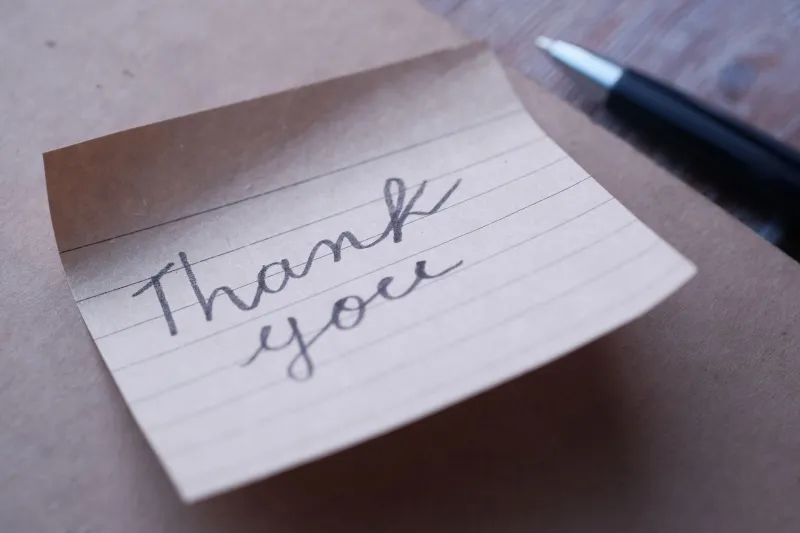
I remember writing it at my old kitchen table, the one with the wobbly leg I propped up with a folded receipt. I wrote something like, 'Thank you for showing up when I couldn't show up for myself.' That sentence was true. It was also only half true.
What I couldn't write was the rest: that Maya had a way of helping that made me feel small. She'd show up with groceries and then say, 'See? This is what happens when you don't ask for help.' She'd listen to me cry and then remind me that her life was harder. She was generous with her time and stingy with her tenderness, and I spent months trying to earn the difference.
Gratitude and resentment can share the same address. That's the part nobody warns you about. You can be genuinely thankful for someone and still recognize that their kindness came with a tab. For a long time, I thought acknowledging that tab made me ungrateful. So I kept the card in a drawer and told myself I'd send it when I felt less complicated.
Gratitude With a Side of Resentment
The thing about unfinished gestures is that they don't stay neutral. They collect interest. Every time I opened that drawer, the card seemed to say two things at once: 'I helped you' and 'You owe me.' I started to dread the sight of it.
I've since learned that this is common. We hold onto unsent messages, unwritten apologies, half-finished conversations—not because we're lazy, but because sending them would force us to choose a story. The tidy version says: Maya was kind, I was struggling, and gratitude is simple. The messier version says: I accepted less than I deserved for a long time, and I called it humility because I didn't know what else to call it.
That's the apology I owed myself. Not for being ungrateful. For treating gratitude like a coupon that made it okay to be talked down to. For confusing 'she showed up' with 'she showed up well.' For thinking that needing help meant I had forfeited the right to have boundaries about how that help was delivered.
The Apology I Kept Addressing to the Wrong Person
Here's what I finally understood: I had been trying to write a thank-you note to someone else when what I really needed was to apologize to the version of me who sat at that wobbly table and swallowed her own discomfort to keep the peace. That girl deserved better than a card she never got to send.
So I did something that felt slightly ridiculous and entirely necessary. I took out a fresh piece of paper and wrote a note to myself. It said, 'Thank you for surviving that season. I'm sorry it took me this long to believe you deserved better than a thank-you note as a coping mechanism.'
Then I wrote a second note—the honest one. 'Thank you for the soup. Thank you for the rides. I'm also sorry I let you talk to me the way you did, and sorry I thought that was the price of being loved.' I didn't address it to Maya. I didn't stamp it. I didn't send it.
What Closure Actually Looked Like
I put both cards in the drawer, side by side. Not as unfinished business. As evidence. The first card is proof that I can hold two truths at once: someone helped me, and someone hurt me. The second is proof that I don't need to mail my boundaries to anyone to make them real.
Closure, for me, wasn't a confrontation. It wasn't a dramatic text or a returned box of belongings. It was finally reading my own handwriting without flinching. It was realizing that the note I never sent had been a question all along: Do I owe you my silence? The answer, it turns out, was no.
I still have the card. I don't open the drawer as often now, but when I do, I don't feel the old ache. I feel something quieter—a kind of tenderness for the woman who wrote it, and a debt I've finally stopped paying. Not every thank-you needs a stamp. Some of them just need to be read by the person who wrote them, in the light of a different day, and then gently set down.