The Photo I Saved Twice: One Without Me, One With the Truth
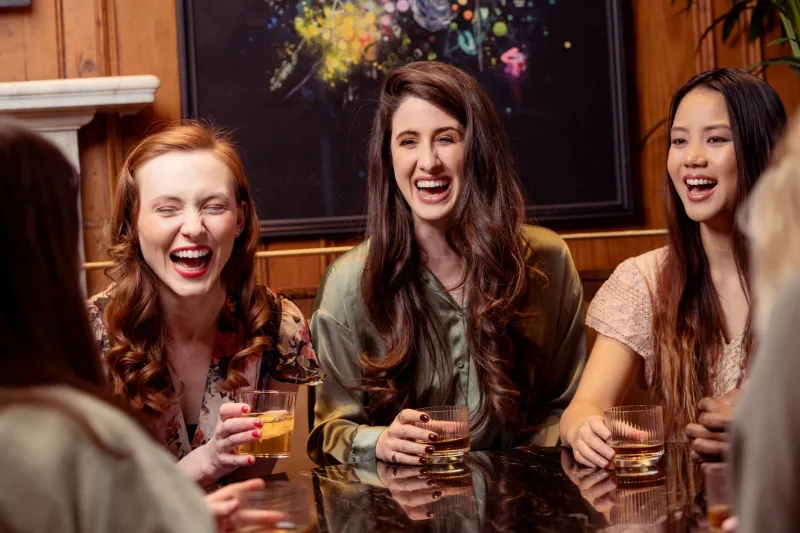
The photo landed in the group chat at 11:47 p.m., backlit by a row of candles and the kind of restaurant lighting that makes everyone look like they're in a perfume ad. Eight of us around a long table, plates pushed aside, somebody's hand blurring through the frame because they were laughing too hard to hold still. I was on the far end, leaning in, mid-sentence. And my first thought was not what a good night. It was yikes.
I know this move. I've done it since camera phones became a thing. Open photo. Zoom in on myself. Find the flaw. It's usually the same trio: my chin, my posture, the smile that looks less like joy and more like I'm being audited. My thumb moved before I made a decision. Photos app. Edit. Crop. Drag the corner until I was gone. Seven people at the table instead of eight. A tidier story.
I sent the cropped version to the group with a caption about how good the cake was. Then I put my phone down and stared at the ceiling, weirdly relieved and weirdly hollow, the way you feel after you've cleaned a room by shoving everything into a closet.
The Thumb That Knew Before I Did
Here's what gets me: I didn't debate it. There was no negotiation. My hand just knew where to go. That's muscle memory, and muscle memory doesn't come from nowhere. It comes from years of practice. Beach photos, wedding group shots, my sister's graduation, that one picture from a work retreat where I was standing at a bad angle and spent twenty minutes trying to fix it before giving up and deleting the whole thing.
I'm not a clinician. I'm just a person with a camera roll full of evidence. But I've learned that this isn't exactly vanity. Vanity would mean I think I'm the most important person in the frame. This is closer to the opposite. It's a preemptive apology. If I remove myself first, no one else has to.
That's the part that worries me. Not the cropping itself. The reflex behind it. The quiet belief that my presence is optional, that the night can be preserved just fine without me in it.
Why Disappearing Feels Like Safety
When I'm not in the picture, I can't be judged in the picture. That's the logic, and honestly, it works. For about four seconds. Then the relief fades and something else settles in, something heavier. Because every small erasure teaches my brain a lesson: you are the problem in the room. Do that enough times and you start to believe it everywhere, not just on a screen.
I've cropped myself out of more than photos. I've left parties early because I felt too big and too quiet at the same time. I've said no worries when there were worries. I've let other people tell stories I was part of because hearing my own voice felt like too much. The crop tool is just the most literal version of a habit I've been practicing for years.
The Friend Who Noticed the Gap
My phone buzzed around midnight. Dana, the birthday person, the one whose night it was. Her text was short: Wait—where did you go?
I typed back immediately, because deflection is also muscle memory. Lol I looked weird. Didn't want to ruin the picture.
Three dots. Then: You looked happy. Put yourself back.
I sat with that for a while. Not the instruction—the observation. She didn't say I looked pretty. She didn't say I was being ridiculous. She said I looked happy. Which meant she'd been looking at the original. She'd seen me leaning in, mouth open, hand flat on the table, completely unguarded. And her takeaway was not yikes. Her takeaway was there you are.
It's strange to be seen that accurately when you've been trying so hard to be seen less. Unsettling and lovely at the same time. Like someone turned on a light in a room you'd been navigating by memory.
The Original Version
I opened my camera roll and found the photo again. The original. I looked at it for a full minute, which is approximately 58 seconds longer than I usually allow. I did not suddenly love it. My chin still did the thing. My smile still had that slightly startled quality. But I saw other things too. I saw my hand mid-gesture, telling a story I can't even remember. I saw the friend next to me leaning into my shoulder, comfortable, like it was the most natural place in the world. I saw the candlelight in a water glass and the empty chair where someone had gone to find the bathroom. I saw a night, not a flaw.
The photo wasn't about my chin. It never was. It was about being part of something. And I was part of it. I saved the original. Then I saved the cropped one too, because I'm not pretending I've fixed myself overnight. I'm just trying to keep both versions around. One is what I did. The other is what I'm learning to choose.
What Being Seen Actually Costs
Being in the frame costs something. It costs the fantasy of a flawless version of yourself. It costs control. It means accepting that people will see you exactly as you are—tired, human, mid-sentence—and that most of them will not be grading you the way you're grading yourself. Most of them will just be glad you were there.
I still crop sometimes. I'm not going to lie to you. The reflex is strong, and a bad angle can still ruin my whole afternoon. But I've started doing one small thing first: I look at the original before I edit. I zoom out. I find the person next to me, the candle in the glass, the blurry hand. I remind myself that the photo is not a mirror. It's a memory. And memories are better with everyone in them.
The photo from Dana's birthday is still in my favorites. Not because I love how I look in it. Because I love that I stayed.